About
Mohammed Umair
My career has never followed a single lane. I began in sales, built a multidisciplinary technology business, and moved into global trade and AI-enabled platforms. The thread has been curiosity backed by execution — understand the problem, bring the right people together, and stay until the work holds up in the real world.

Turning points
- 2000
Learning to win a customer
It started with a small venture assembling, selling and servicing PCs, then years in sales and financial services. I learned how organisations sell, train and decide — that every system is really a set of incentives.
- 2010
One team for the whole building
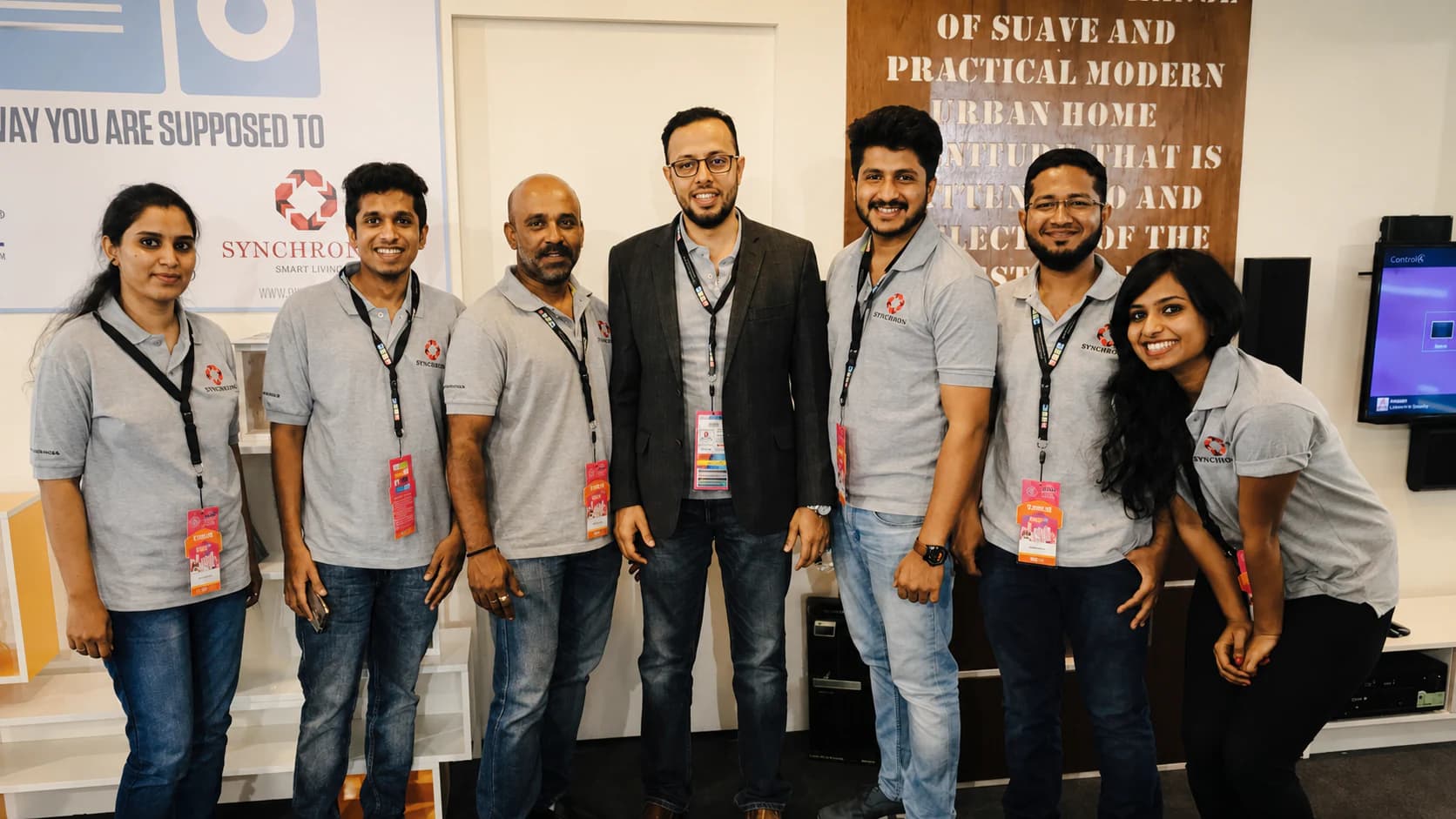
I founded Synchronos because clients were forced to coordinate designers, automation, AV, security and contractors themselves. We put it all under one accountable team. Buildings taught me that projects fail at the joints between disciplines, not within them.
- 2024
Designing a market before it opens
At T57 I moved from delivery to commercial strategy (which markets, at what price, through which partners) for an AI-native food ecosystem that has not launched yet. Different material, same discipline: understand the real problem before committing.
- 2025
Software that starts from the problem
NxSync grew out of frustrations in my own operations. I began directing enterprise software (an AI-native ERP, secure collaboration) written from a business problem down, in reviewable stages, not from a feature list up.
- 2025
Keeping the reasoning
Building with AI, we moved faster than any team I had run and lost the reasoning behind our decisions at the same speed. VeraKeep was the answer — and the most abstract system I have built: the decisions themselves. (Spine became VeraKeep in 2026.)
- 2026
Turning operating knowledge into reusable systems
The same discipline kept showing up in different materials, so I started writing it down as systems rather than one-off habits. GrowthOS came from watching growth work stay fragmented across separate tools with no shared evidence. The specialist AI skills came from turning working methods (how I diagnose a decision, research a market, write for a real audience) into something reusable rather than re-explained each time. Selling What's Complicated codified two decades of commercial experience into a system a team could actually run, not just a memory I carried. None of these are side projects; they are the same operating philosophy, applied one level more abstractly each time.
These are the same five systems you can explore in the work.
How I think about learning
Every few years my work has required me to become a student again: insurance products, then structured cabling and acoustics, then trade finance and market entry, then machine learning and software architecture. I have stopped treating that as a detour and started treating it as the job itself.
My method is unglamorous. Read widely, ask people who know more than I do, and get close enough to the detail to hold a real opinion. I don’t need to be the best engineer or economist in the room, but I need to understand enough that nobody has to simplify the truth for me.
How I work with people and teams
I have spent most of my career working with people whose skills I do not share — carpenters and network engineers, ML researchers and salespeople. What I bring is the translation between them: turning a business requirement into something a technical team can build, and a technical constraint into something a commercial team can plan around.
I hold two habits firmly. Work should be defined before it starts, including what finished means. And every seam between disciplines should have an owner. Beyond that, I try to give capable people room, and to stay close enough to the work that problems reach me while they are still small.
What I am focused on now
Three things, mostly. Helping T57 move from planning towards launch. Growing NxSync’s platforms one deliberate stage at a time. And understanding, through daily practice, how AI changes the way businesses should be run — not as a slogan, but as an operating question I am working out in real projects.
What has my attention right nowQuick answers
Who is Mohammed Umair?
Mohammed Umair is a business builder and operator based in Bengaluru, India. He founded and runs Synchronos, a smart-infrastructure company, and now directs commercial strategy at T57 and an enterprise-software portfolio at NxSync.
What does Mohammed Umair do?
He builds and operates businesses with founder-level accountability, from physical systems integration to international market entry to AI-native enterprise software, moving between commercial strategy and hands-on delivery rather than staying in one lane.
What industries has he worked in?
Financial services and sales, smart infrastructure and building technology, international food and agricultural trade, and enterprise software and AI — each taken up in sequence, with lessons from one carried directly into the next.
Where has he worked?
He is based in Bengaluru and has worked across India, Saudi Arabia, the UAE, Qatar and Morocco, with his current commercial and product work spanning India and the wider MENA region.
What kinds of systems has he built?
Physical systems integration at Synchronos (automation, AV, security, interiors); commercial architecture for a pre-launch trade ecosystem at T57; and enterprise software (an AI-native ERP, secure document collaboration and an AI delivery-governance tool) at NxSync.
Recognition
- 2022Panasonic Partner Recognition — Panasonic
- 2018Insights Success Cover Feature — Insights Success
- 2018SiliconIndia Recognition — SiliconIndia
- 2019Smart Living Innovation Award — India SmartTech Conference
- 2009AEGON Religare Annual Star Award — AEGON Religare