T57 Digital Agriculture Module · Product Concept & Direction
Connecting farms, markets and money in one working module
A module within the T57 AI-native food ecosystem
Agriculture runs on information that refuses to sit in one place. A grower manages fields in a notebook, finds buyers through brokers, and settles payments wherever the buyer insists. Each step works after a fashion — but nothing connects, and the grower carries the cost of every gap.
This is the first substantial build within the T57 AI-native food ecosystem: a module that tests the connection itself — farm operations, marketplace trading and financial workflows in one system, delivered as a working Phase 1.
The fragmentation problem
Farm records tell you what was planted and done; marketplaces tell you what is for sale; payment systems tell you what moved. Kept apart, each is weak: the marketplace listing cannot prove where the produce came from, the farm record earns nothing, and the payment says nothing about what it paid for.
The premise here is that the value is in the joins. A listing that traces back to a real plot and its recorded activities is a different commercial object from an anonymous advertisement — and a wallet that lives beside the order flow makes settlement part of the trade rather than an afterthought.
One module, many operations
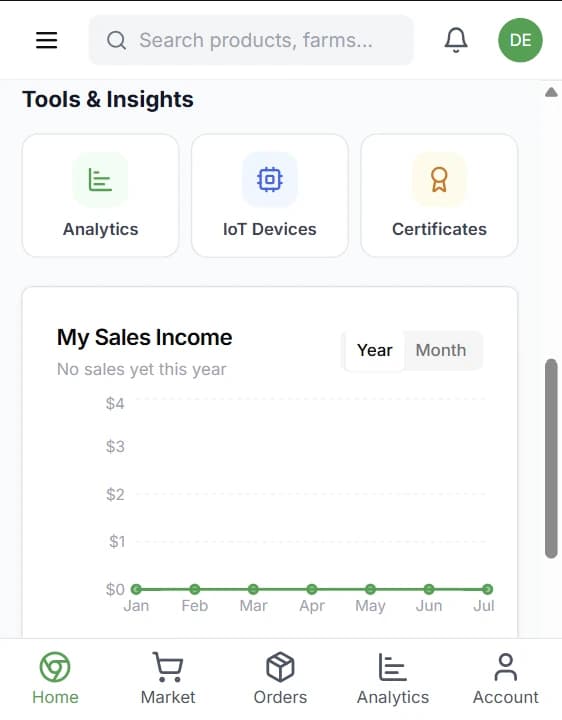
The module is multi-tenant from the ground up: each organisation operates its own farms, plots, listings and orders inside its own boundary, enforced at the database layer rather than in application goodwill. Farms break down into plots with recorded field activities; produce moves to a marketplace with distinct buyer and seller experiences; orders and a wallet carry the transaction; certificates and analytics sit alongside.
What Phase 1 completed — and what it did not
Phase 1 delivered the working spine: tenancy, farms and plots, field activities, marketplace, buyer and seller flows, wallet and order concepts, certificates, notifications and analytics, on a schema with row-level security throughout. It builds and runs as a working MVP.
Just as deliberately, Phase 1 excluded what was not yet earned: IoT telemetry, satellite and weather intelligence, and production-scale cloud infrastructure remain future work, designed for but not built. Keeping that line honest (declared future work rather than quiet vapourware) was a product decision, not an engineering accident.
A module within the T57 ecosystem
This is one module inside the wider T57 AI-native food ecosystem — not the whole of it, and not a separate company. T57 is the ambition across food and agriculture: commerce, trade, logistics, finance and data. The Digital Agriculture Module is where that ambition first became working software, focused on farms, a marketplace and settlement.
The AI/ML team continues to work on the module. Its Phase 1 is complete and demonstrable; the broader T57 ecosystem remains pre-launch. The two are never the same claim.
Current stage
The module’s Phase 1 is a completed, working MVP: multi-tenant farm management, marketplace, wallet and order workflows, certificates and analytics. IoT, satellite and weather intelligence and production cloud infrastructure remain designed-for future work. The wider T57 ecosystem stays pre-launch.
- 01
Farm & plots
Operations recorded where they happen
- 02
Field activity
What was done, and when
- 03
Listing
Produce offered with its provenance
- 04
Order
Buyer and seller in one workflow
- 05
Wallet
Settlement beside the trade
- 06
Analytics
What the operation learns
What the work taught me
Scope discipline is a feature. The module is credible precisely because Phase 1 refused to pretend: what works is built and demonstrable, what is future is labelled future. In agricultural technology, a field crowded with renders of drones over wheat, restraint turned out to be the differentiator.
One module of the T57 ecosystem, where a market conviction becomes working software from the farm upward.