Quest Next · Product Concept & Design Direction
Turning family routines and goals into shared quests
A Synchronos project
Households do not fail at routines for lack of information — everyone knows the dishes exist. They fail for lack of motivation structure: effort is invisible, credit is unevenly given, and the only feedback loop is a reminder that sounds like nagging.
Quest Next turns family routines, responsibilities and goals into shared quests — with roles, rewards and progress a household completes together.
Designing for two audiences at once
A family product has the hardest UX brief there is: the same system must feel like a tool to a parent and a game to a child. Parents create and approve; children complete and earn. The approval step is the heart of it — effort is claimed, then confirmed, so credit means something and the reward loop cannot be gamed by the fastest tapper.
Motivation without manipulation
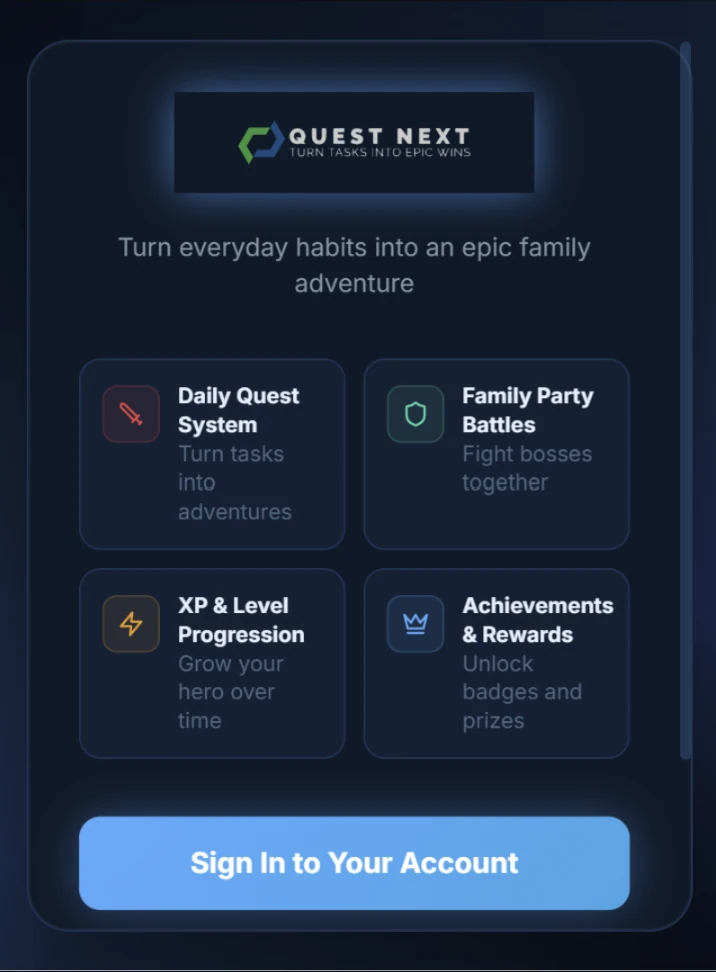
The reward system borrows honestly from games: experience points and gold, achievements, streaks, avatars, virtual pets that grow with care, cooperative challenges the family faces together, and a shop where earnings become privileges. Habits, personal goals, milestones and to-dos carry the everyday load alongside the quests.
The design line I held: rewards celebrate effort, they never punish its absence. There are streaks, not shame; cooperative bosses, not leaderboard humiliation. Gamification in a family setting is an ethical exercise — the same loops that motivate can coerce, and the difference is design intent.
A complete product, not a demo
Quest Next is a completed application: family groups and roles, quest creation and approval, the full reward economy, pets, achievements, challenges, shop, and family and subscription settings, with persistent per-family data underneath. It is the portfolio’s clearest exercise in human-centred design — the engineering serves an emotional outcome, a household that wants to keep its own promises.
Current stage
A completed application, built through to the full feature set with family data persistence. It is a finished build rather than a publicly launched service.
What the work taught me
Behaviour design is systems thinking with feelings in the loop. Every mechanism (approval, streaks, pets, shared bosses) is an incentive structure, and families test incentive structures harder than markets do. Building Quest Next sharpened a conviction that runs through all my product work: software changes behaviour, so its designer is responsible for which behaviours.
The people-first lens here is the same one that keeps the enterprise systems honest — software is only finished when humans willingly use it.